
Secure Your Position: Capitalizing on the Next Wave of Bucharest Growth
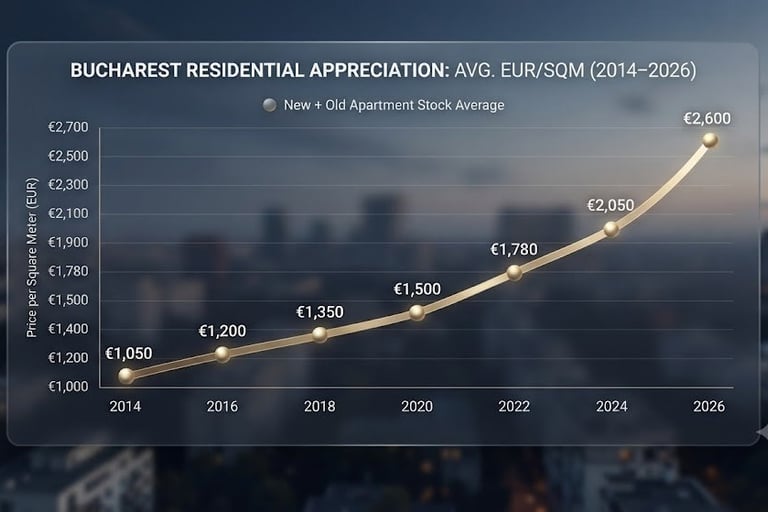
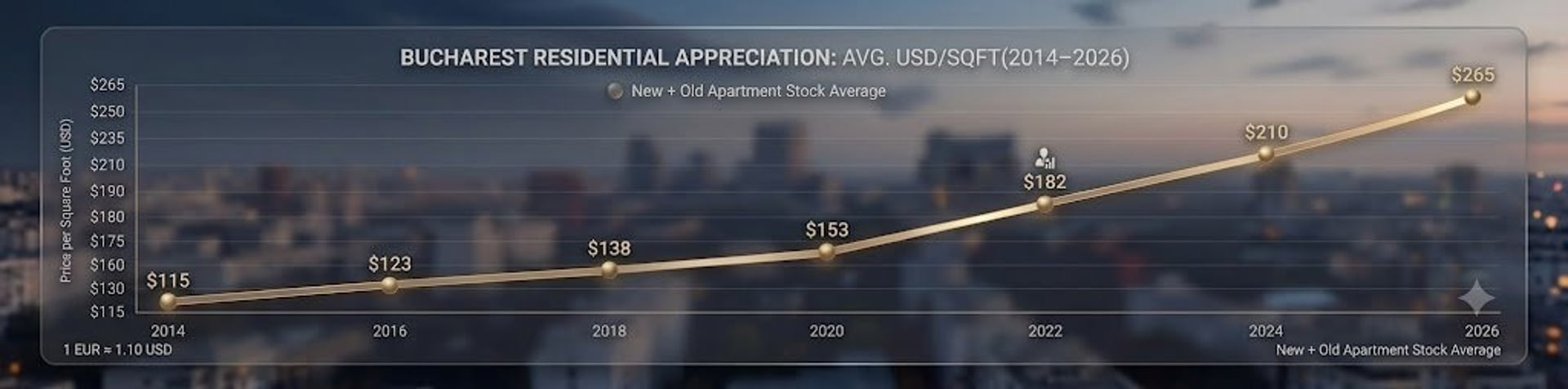
Over the past decade, the Bucharest residential real estate market has experienced a consistent upward trajectory, steadily growing in profit and value since its post-crisis recovery. Driven by a combination of heavily constrained housing supply and robust buyer demand, nominal property prices have climbed year after year, with average apartment prices reaching between €2,150 and €2,204 per square meter by 2026. This decade of uninterrupted appreciation has generated highly attractive rates of return for investors. Beyond the substantial capital gains—where well-located, renovated apartments are currently seeing annual appreciation rates of 13% to 15%—the market also benefits from strong rental yields that have been increasing across major Romanian cities, heavily compounding the overall profitability of these real estate investments.
Beyond the immediate supply constraints, several macroeconomic and infrastructural catalysts are poised to accelerate market growth as the timeline extends past 2026. While elevated mortgage rates and inflation temporarily cooled transaction volumes earlier in the year, the market demonstrated a strong rebound by mid-year, surpassing 10,000 transactions in June alone and signaling resilient buyer appetite. As the central bank is expected to initiate interest rate cuts, mortgage lending will become more accessible, injecting fresh liquidity into the market and likely triggering a renewed surge in demand by 2027. Furthermore, ongoing infrastructure developments, such as new metro line expansions, are significantly boosting property values in key northern and central districts. Because buyers are increasingly prioritizing long-term value, energy efficiency, and proximity to major transit hubs, these prime real estate assets are structurally positioned for continued, long-term capital appreciation.
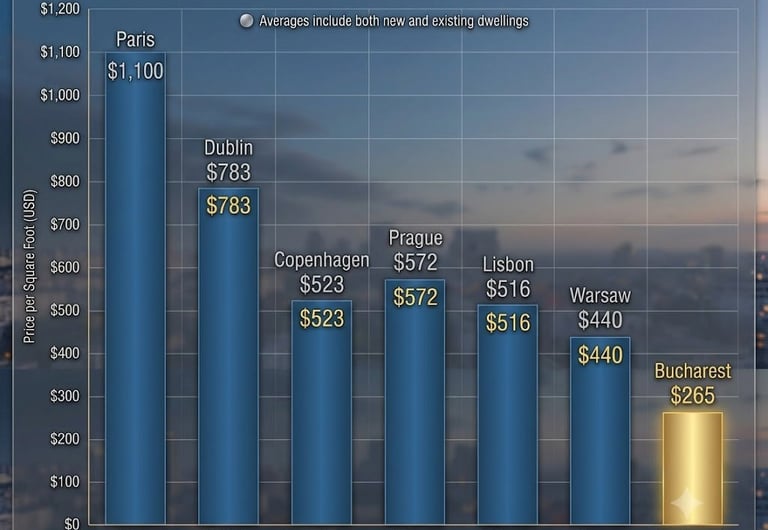
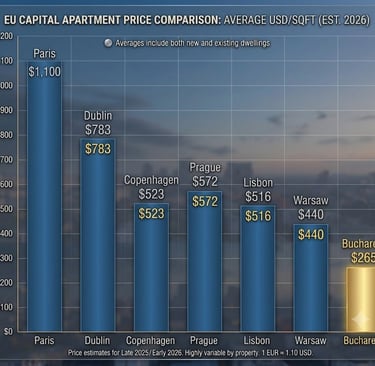
When evaluating Bucharest's average price of approximately $265 per square foot, the value proposition is striking compared to the real estate costs in other European Union capitals. At the highest end of the spectrum, securing a property in Luxembourg City or Paris requires a massive capital outlay, averaging roughly $1,132 and $1,100 per square foot, respectively. Other major Western European hubs like Amsterdam and Dublin also present extreme barriers to entry, with average prices sitting around $802 and $783 per square foot. Moving toward Northern and Central Europe, prices remain heavily elevated; a buyer can expect to pay approximately $523 per square foot in Copenhagen and $572 per square foot in Prague. Even in capitals that share similar regional economic trajectories with Bucharest, the costs are notably higher: properties in Warsaw average about $440 per square foot, while those in Bratislava sit near $409 per square foot. Further south, markets historically seen as accessible have also grown significantly, with average property costs reaching around $516 per square foot in Lisbon and $278 per square foot in Athens. Ultimately, Bucharest stands out as one of the few remaining major EU capitals offering premium, rapidly modernizing real estate at a highly competitive entry point.
The European Convergence: The Catch-Up Trajectory
We have already seen this movie, and we know exactly how it ends. When former Eastern Bloc countries fully integrate their infrastructure and corporate sectors with the EU, their capital cities undergo a violent upward price correction to match Western European baselines.
The Precedent (Warsaw & Prague): Twenty years ago, Prague and Warsaw offered the exact same "discount" that Bucharest offers today. As foreign direct investment poured in and highways connected them to Germany, their real estate markets skyrocketed. Today, Prague averages over €7,200/sqm, and Warsaw is rapidly approaching €4,500/sqm.
Next in Line (Bucharest): Bucharest boasts a larger population than Warsaw, a faster-growing GDP, and a booming tech sector—yet it is priced at a fraction of the cost. As Romania fully integrates into the Schengen zone and its highway network physically links it to the West, the current €2,250/sqm price tag will disappear.
The Closing Window: Institutional money is already realizing this reality. In 2025 alone, Bucharest saw nearly a 17% year-over-year increase in asking prices. Buying now means securing your asset right before the window closes.
Connecting to Europe: The A1 Corridor & Future Appreciation
The imminent completion of the A1 highway over the next one to two years represents a watershed moment for the real estate market in Bucharest. Once the final construction phases are finalized, Bucharest will be seamlessly connected to the Western European highway network. This physical integration fundamentally alters the economic geography of the region. By drastically reducing transit times and logistics costs, the completed A1 will accelerate foreign direct investment and remove the final infrastructural barriers that have historically kept Romanian real estate at a discount compared to its Western peers.
As a direct consequence of this new connectivity, property values in Bucharest are positioned for a rapid, structural correction toward standard European baselines. Historical precedents show that capital cities experience aggressive real estate appreciation once they are fully integrated into the EU's core transit infrastructure. The influx of multinational capital and the optimization of commercial supply chains along the A1 corridor will drive intense demand for premium residential space, acting as a powerful catalyst to push Bucharest's prices higher and rapidly close the gap with established Western capitals.
The Infrastructure Effect: A Proven History of Wealth Creation
In European real estate, nothing drives property appreciation faster than new highways and transit connections. The completion of major transit corridors drastically reduces transport times, accelerates commercial investment, and creates immediate, sharp increases in local property values.
You do not have to guess if this will happen in Bucharest; you only need to look at recent history:
The Cluj-Napoca Boom (The A3 Catalyst): A little over a decade ago, Cluj-Napoca was an affordable university town. However, the expansion of its international airport and integration with the Transylvania Motorway (A3) connected it directly to Western European markets. Real estate values exploded. Today, Cluj is the most expensive real estate market in Romania, with prices exceeding €3,230 per square meter—having vastly outpaced the capital itself.
The Sibiu Surge (The A1 Gateway): Following its designation as the European Capital of Culture, Sibiu’s real estate market was permanently transformed by its connection to the A1 highway. By linking Sibiu directly to the Hungarian border and the broader Western European transit network, the city became a highly accessible hub, driving years of sustained, double-digit property appreciation.
The European Precedent: This pattern repeats constantly across the continent. In Poland, the completion of the A2 highway linking Warsaw to Berlin triggered a massive surge in property values along the corridor. In Portugal, the current development of the Lisbon-Porto high-speed rail line is already pushing property values up by 8% to 12% annually in connected cities.
Bucharest is currently undergoing this exact same transformation with the imminent completion of the A0 Metropolitan Ring Road and critical segments of the A1 and A7 highways. Buying now means capturing the "infrastructure premium" before it is fully priced into the market.
Contact
PHONE / WHATSAPP
prisacadornei10 (at) gmail.com
+40-0723.378.959